Showing posts with label Tutorials. Show all posts

Sanskaar - Teaching Kids Good Things

Sanskaar
Sanskaar            PC: - VaniaRaposo
We must teach our daughters the difference between:

A man who flatters her & a man who complements her.
A man who spends money on her & a man who invests in her.
A man who treats her as property, & a man who treats her properly.
A man who believes he's her God, & a man who thinks she's an equal.

And if we have sons, we must teach them to be a great man.

How To Get Rid Of Back/Knee Pain In 5 Minutes ?


Due to changing lifestyles, most of the people have to sit in one place for many hours. It is a dangerous habit. Like machines get rusty when kept unused for an extended period, so is our body. Sitting in one posture for a long time repeatedly can cause critical damage in the long term. Not only can it cause joint pain and back pain, but it can also cause diabetes, high/low blood pressure, obesity, etc. So, while working on the laptop or sitting in your chair, try to take a break every hour. Just go for a walk and move your body parts.

However, if you experience back pain or knee pain, due to physical stress, here is a simple method to get rid of it temporarily. It is an acupressure point, shown in the pic below. It lies between the fleshy part located between your thumb and forefinger. Just press this area along the bone of your thumb and try to find the point which is aching the most. This point has a nerve ending which meets with the point in the spinal chord that is aching. Press this point for 1 minute; rest for 20 seconds and again press it for 1 minute. Continue this process for 5 minutes. You'll find that your pain has reduced considerably. Repeat this process three times a day until the pain is cured in your acupressure point.


Acupressure Point for Back/Knee Pain Release

Stock Markets and Emotions

A happy dog :)
A happy dog :)
How do you feel after seeing this image? You must be feeling happy, right? After all, it's not every day when you see such a happy dog!

Humans are emotional animals. We get easily angered, happy, excited and gloomy over ordinary things. For example, in news channels, we almost always hear the negative news. Even mild incidents are presented in such a way it makes us think that there is nothing except negativity in entire India. They try to make us bitter and angry, and we quickly become bitter and angry. But sometimes when we hear a positive news, we become happy and excited too. A simple report, a simple sentence, a positive quote and a picture can change our emotions completely.

Similarly in stock markets we encounter emotions every day. These emotions, if unchecked, can harm us a lot and the same emotions can be used to our advantage as well!

Bull market and Bear market

When people are confident about the economy and stock markets, then they're willing to pay a higher price for stocks and these stocks (generally) trade at a higher price to their fair value. It is described as a bull market and these confident people are called bulls.

Similarly, when people are negative, then they sell their stocks at a lower price(sometimes much lower than their fair values). It is known as a bear market and these people are called bears.

So sometimes we have a bullish market and sometimes we have a bearish market.

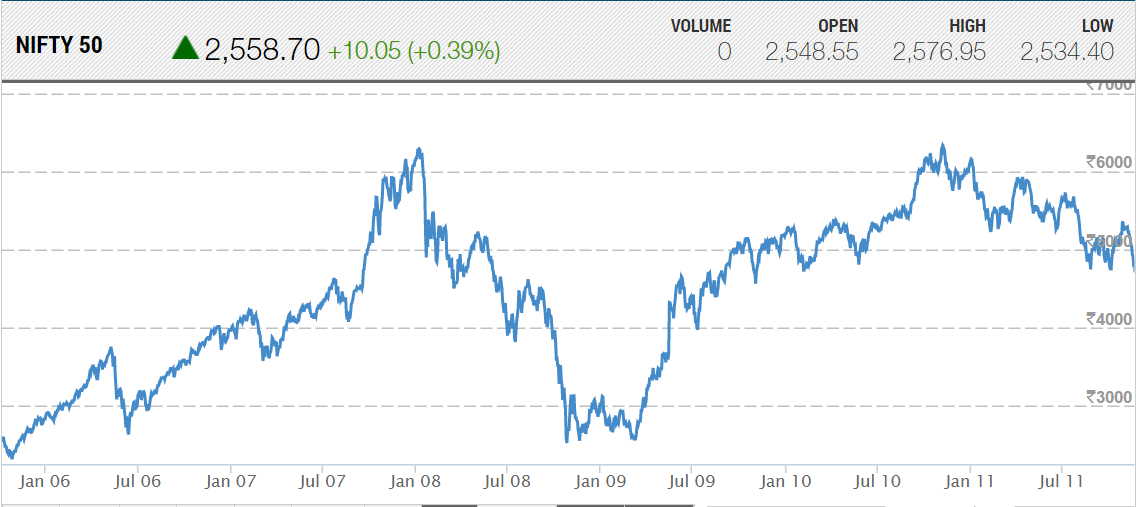
See this chart of Nifty 50 that represents the weighted average price of top 50 companies in India. It is in between 2006 to 2011.


You can see that between January 2006 and January 2008, Nifty is crazily going up. During this period euphoria was rampant in the market. Most of the stocks became highly overvalued. It was an incredibly bullish market.

And then 2008 came and with it came the global recession. Within few months, Nifty went tumbling down from a high of 6000+ to sub 3000 levels. It was an incredibly bearish market. Most of the stocks were trading at far lower prices compared to their fair values.

As you can see that Nifty recovered in a few months, but it took some time for it to achieve its previous high. Nevertheless, if you're a skilled investor, you'd have sold your stocks when the markets were extremely bullish and you'd have bought a lot of shares when the markets were bearish. It's common sense, right? A simple strategy. Wait for the global recession, buy quality stocks in that downturn, and keep holding them till the market becomes extremely bullish again. The human psychology is not so easy to understand.

The psychology of human misjudgement

Do you know that almost all of our decisions are based on what others around us are doing? We like the things our friends like. We like people that our friends like. We select the courses that our friends are choosing. We vote for a political party based on what the crowd around us are doing and the general perception about it. We are vegetarian(or nonvegetarian) because of our families and friends. In fact, we are more likely to do what people expect from us. It is a typical bias, known as Social Proof.

 Social proof is a psychological phenomenon where people copy the actions of other around them to reflect the correct behaviour for a given situation.

And this behaviour is also seen in the stock markets.

In a highly bullish market, you'll see people making a lot of money around you. It will be tough at that time to just sit on your ass and do nothing. You'll become jealous of people who are minting money so quickly. It will be very tempting. And one fine day you'll just lose your patience.

Similarly in a bearish market, there will be so much negativity around you that it'll scare you to your core. Everyone you meet would have lost a lot of money. They'll tell you that investing in stocks is gambling. They'll tell you to keep your money in FD. Don't listen to them. They are the same people who'll be the first one to buy stocks in the next bull market.

So if you can't control your emotions and if you can't keep a relaxed mind, both in a positive and negative environment, then stay away from stocks. It's not for you. But if you're one of those rare individuals, who like to use their brain and who have the patience to wait, then you'll make reasonable returns here.

Note: I'm not saying that buy only in a bear market and sell only in a bull market. The right decision depends on individual stocks. You'll find both types of opportunities in both markets.


Introduction to Stock Market - financials

Dalal Street Bull
Even stock markets have bulls!
My previous post on equity markets received a good response, so I decided to continue educating our followers about the wonderful world of shares. By the way, in India, just 2% of population invest in stocks, while in developed countries like the US, almost 50% people invest in stocks.

It hurts to see that most of our very profitable companies (which we call 'Indian') are owned by FIIs (Foreign Institutional Investors) and FPI (Foreign Portfolio Investors). For example, more than half of HDFC bank, which is the most valued bank in India and the second most valued bank in the entire world, belongs to foreign investors. Just a few thousand invested in HDFC bank, 20 years ago, would be worth crores by now. Similarly, Indian people have lost billions of dollars of profits, in many companies, to foreign investors. Just because most of the Indian investors invest for short term, they can't hold high-quality stocks for the long term, and thus, most of us aren't able to build wealth in equity markets.

The power of compounding

The human brain isn't wired to process compounding. Our brain can process arithmetic progression. You can quickly calculate the result of adding a number 10 times. But can you calculate the result of growing a number by 15% every year for 30 years? Take a guess. 

Let's see the result of compounding  INR 1 lac at 8%, 15%, 20%, 25% and 30% for 30 years.
                     
Compounding for 30 years
You can see that at 8%, which is our current (government bonds, FDs)interest rate and which is going to go down with time, the amount will become INR 10 lacs. If I include the tax on interest, the final value will be very less. 

But suppose you get your hands on a stock that grows by 15%, 20%, 25% or 30%. Isn't the contrast between the end results astounding! Increase the time by 30 years more and you won't believe your eyes.

For 60 years.
                                             
Compounding for 60 years
It is the power of compounding. I assure you that it's near impossible to see 30% compounding for such a long time. Even 20-25% compounding is hard. But many Indian companies like Nestle, HUL, Infosys, TCS, Asian Paints, Kansai Nerolac, Apollo Hospitals, ITC, HDFC Bank, HDFC, Kotak Mahindra Bank, etc., have given such kind of compounding in the past. Some of these have given even more than 30% for a specified period of time. And that's why these companies have become so big. But after a certain size, growth starts slowing down, and that is natural. 

That's why we should try to spot these companies when they are small in size. But even now, after becoming big some of these businesses will continue giving superior returns compared to fixed deposits and government bonds. The trick is to buy them below their fair value and keep holding on to them. If you pay a very high price(much higher than the fair value), even for the greatest company, you're going to lose money. But I'll come to the concepts of valuation later. For now, let me make you guys familiar with certain terms and ratios used while evaluating a stock.

Stock market jargon     

Here are some financial terms you'll encounter while studying financial results of a company.             

Accounting period: Financial statements are made for a fixed period. For most of the companies, the annual accounting period is from 1st April to 31st March, and this annual period is divided into four parts of 3 months each, called quarterly periods. Every listed company publishes quarterly results and annual results. They also publish an Annual Report of the business every year.

These are the terms you can find in a typical profit/loss statement.

Sales/Revenue/Total Income: Value of the products sold/ or services delivered during an accounting period.

Operating Profit(OP): Think of operating profit(EBITDA) as profit you get after you cover the costs of running your day to day business like Raw material, Salaries, Maintenance, Marketing expense and other business expenses. So OP it is Sales minus operating costs. 

Operating Profit Margin(OPM):  Operating profit/Sales. The higher the OPM, the more efficient the business (because it has lesser costs compared to its competitors). 
It is also known as EBITDA - Earnings before interest, tax, depreciation and amortisation.

Net Profit: Operating profit -  (other costs like Interest paid on debt and depreciation/amortisation of assets)  - tax paid for the period  

EPS:   Earnings per share =  (Net Profit)/(No of shares). Suppose the company has INR 10 crore net profit and it has one crore outstanding shares, so its EPS becomes 10/1 = 10/share. 

P/E:  Price to earnings ratio is (the Current trading price of the stock)/(EPS). 
Let's take the above example.  Suppose the current price of the stock is INR 100/share and EPS is 10, so the P/E becomes 10. Generally speaking, the lower the P/E, the cheaper the stock price. But P/E ratio, in isolation, can give a wrong picture of the stock. It is a useful tool in comparing a stock to other stocks in the same industry(or comparable).

Now let me give you an example of a profit/loss statement

Income Statement
Income Statement

The is a snapshot from the Dec quarter result of Hatsun Agro Ltd, A south based dairy products company.

You can see Total Income from operations, amortisation which is 830 crores(For Dec-15),  it's also known as sales and revenue. 

You can see "profit from operations before Other income and finance costs" which is 43.53 crores. Add to this Depreciation and Amortization expense (27.12 crores) and you'll get Operating profit(EBITDA) which is 70.65. (Note: depreciation and amortisation are not operating costs)

You can see net profit which is 17.55 crores for the dec-15 quarter.

Now for finding EPS, we need to find the total number of shares. You can see share capital, which is 10.87 crores with a face value of INR 1. Just divide the share capital by the face value and you'll find the total number of shares. Total shares = 10.87/1 = 10.87 crores. 

So, EPS for the December quarter is 17.55/10.87 = 1.62 

You can compare the dec quarter results with the previous quarter results given above and check the growth rate of the company and the improvement in operating profit margins. You can also see the 9 month results(from April to Dec) and you can see that the net profit(EPS) growth is very fast - from 2.83 to 7.11. What do you think is the reason for this EPS growth? Analyze the statement again and give your answer in comments.

P/E ratio can't be determined from quarterly EPS, and we won't know the annual EPS till the march quarterly results are out. But by observing the growth rate in EPS, and by observing the 9 month EPS (which is 7.11), we can make an educated guess of about 9.5 annual EPS. The current share price is 414, so estimated P/E ratio would be 414/9.5 =  43.35. Does this stock look expensive to you?

I think this is enough for now. In the next post, we're going to look at certain Balance Sheet terms. If you've any questions, please feel free to ask.


Is your money really growing in Fixed Deposits?

Are you one of those people who keep most of their savings in their bank accounts? If yes, then I have some bad news for you. While you may think that the money you've invested in fixed deposits is very safe and its value is growing every year, in reality, you couldn't be further from the truth.

Yes, I agree that your money is increasing by 8%(after taxes & fees) every year. But does its value increasing? Let's see.

INR 1 crore, invested at 8% compounded interest rate, ten years ago, would have become INR 2.15 crores today. That looks like a huge gain; your money has more than doubled, right?

Now think about what you could have bought for INR 1 crore, ten years ago.

Think about real estate. In last decade, housing prices have gone up by 5x-10x(even 100x at some places), all over India. So a plot of land, which you could have afforded ten years ago, has become so expensive that the interest which you've earned won't even cover it by half!

Think about everyday household items that you use. Most of the branded items like shoes, hair oil, food, etc., have become 3x-4x expensive.

In fact, the real inflation rate, not CPI or WPI but what we experience, is about 10-12%. So you're losing money like anything while you think it's safe! Is that what you want?

How can you beat inflation?

Well, don't worry if until now you've "invested" in fixed deposits. Worrying won't change anything. But now that you know what the problem is, you can do something about it. 

Since most of you're employed, it would be difficult for you to start your own business. That leaves you with three options - real estate, the stock markets and commodities(chiefly gold). 

Real estate is a tricky investment. You've to know many things like location, expected development, price, etc. Plus when you part with your investment, you've to pay at least 20% ltcg tax and 3% cess. If can really give enough time to check all the facts, then you can invest in real estate.

Even gold has been proved to be a sound investment over the long term. In last ten years, it has gone up about 4x, which turns out to be about 14% CAGR, which is an excellent return. Though from last few years, it has come down a little bit. I don't know much about gold so I won't elaborate further but you can google it. You can also take a look at platinum, which cheaper than gold nowadays! But remember, like real estate, even investment in gold will be taxed at similar rates when you sell it.

The stock market can also be a very rewarding investment. You may have heard of people like Rakesh Jhunjhunwala and Warren Buffett, who have made billions from the equity markets. The most notable advantage of shares over real estate and gold is that, in India, LTCG(long term capital gains) in stocks are completely tax-free! Let me elaborate on stocks a bit.

Stock Market

BSE Sensex has 16.4% CAGR growth rate since inception.

Sensex since April 1979

Some businesses need external funds to grow - for starting new factories, for expanding distribution/marketing network, etc. When a business achieves sufficient size or when the owners of a company want to sell a part of their business, they come with an IPO(Initial Public Offering) to the stock markets. During an IPO, investors(like you and me) can buy the shares of the company. 

A Share or Stock represents a (small) part of a company. For example, if a company has ten lacs total outstanding shares and you own 10000 shares of the company, then you're 1% owner of the company.

After the completion of IPO, the shares of companies are traded on Bombay Stock Exchange(BSE) or National Stock Exchange(NSE) or both. So you can buy shares of any listed company through these stock exchanges. 

Why invest in stocks

If you think that a business can grow a lot in coming years or if you believe that the shares of a company are trading below their expected fair value, then you can buy its shares. 

For example, three years ago, when microfinance industry was going through a crisis, I felt that SKS Microfinance LTD was trading below its fair value. So, I accumulated its shares at an average price of INR 150.

Stock Price of SKS Microfin

On Friday, its closing price was 546. So, it almost has been a 4 bagger(yes that's what we call it) for me in 3 years. And that's been possible because its profits have grown at a healthy rate.

Similarly, there are other businesses that have grown a lot over many years. Take Eicher Motors Ltd, the maker of 'Royal Enfield' bikes, as an example.

Stock Price of Eicher Motors

It has shown an astounding growth of 17-18x over the last five years. And what is the reason for such an increase in its share price? Simple because its profits have grown at a very fast pace and because it was undervalued.

But not all companies give such kind of returns. Take SBI, which is a poorly managed bank, as an example.

Stock Price of SBI
Stock Price of SBI

As you can see, SBI has destroyed shareholders' wealth over the last five years. It is because the business isn't performing very well. Did you know there is four lacs crore worth of bad loans (like Mallya) in our banking system and most of them are in public sector banks; meanwhile, private sector banks like HDFC Bank, Yes Bank and Kotak Mahindra Bank are growing at a decent pace!

So the moral of the story is that you can earn a lot of money from the stock market provided you select right stocks at low prices and keep on holding to those stocks for the long haul. And amazingly you don't even have to pay taxes on your long-term gains! You can beat the shit out of inflation. So think again the next time when you're going to "invest" your savings in fixed deposits!

*If you want more articles on stocks, you can request in comments.


Go Top